
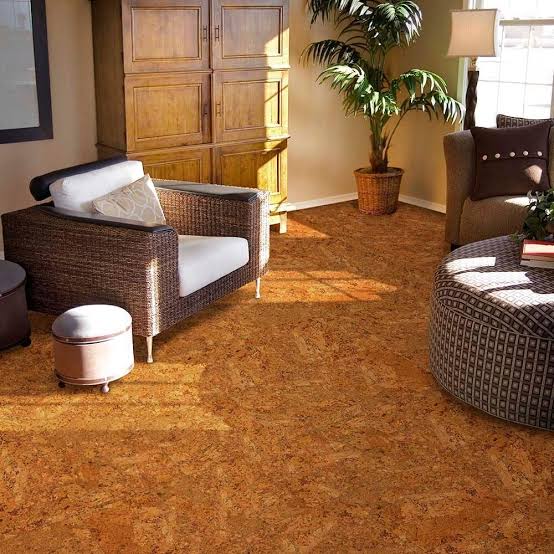

The Material That Peaked in Popularity and Hasn’t Been Given Its Due Since
Cork flooring had a moment of mainstream popularity in the 1970s and early 2000s, then largely faded from residential design conversations as hardwood and luxury vinyl dominated. The cork flooring available today is a genuinely better product than those earlier generations — more durable, more dimensionally stable, available in more styles, and better suited to the range of residential applications where its unique performance characteristics are genuinely advantageous.
Cork’s performance profile is unlike any other residential flooring material: it’s soft and resilient underfoot, thermally insulating, acoustically absorptive, antimicrobial, and sustainably harvested without killing the tree. These aren’t marketing claims — they’re the material science of what cork actually is and how it performs. Understanding them helps identify where cork genuinely excels and where other materials are better choices.
The Comfort Underfoot That Other Floors Can’t Replicate
Cork’s cellular structure — millions of air-filled cells per cubic inch — gives it the resilience that makes it dramatically more comfortable to stand on than any hard flooring material. Standing on cork for an extended period in a kitchen produces noticeably less fatigue than standing on tile, hardwood, or vinyl. This physical property is the result of cork’s cellular compression and recovery — it gives under pressure and returns to its original thickness, creating a continuously cushioned surface.
For households where kitchen fatigue, joint discomfort, or simply the preference for softer underfoot feel matters, cork provides a comfort level that area rugs on hard floors only partially replicate. People who live with cork kitchens and laundry rooms consistently cite the comfort as the feature they’d be most reluctant to give up.
Sound Absorption: The Performance Benefit Most Visible in Multi-Story Homes
Cork absorbs both airborne sound and impact sound — the two categories of noise transmission in residential construction covered in earlier articles. Its sound absorption performance is among the highest of any residential flooring material, which matters significantly in multi-story homes, above basements used as play or media spaces, and in any room where footstep noise transmission to adjacent spaces is a concern.
The IIC (Impact Insulation Class) rating of cork flooring significantly exceeds that of hardwood and tile at the same thickness. For upper-story rooms in homes where noise transmission is a daily issue, this performance characteristic makes cork a serious candidate even for people who wouldn’t have considered it based on aesthetics alone.
Moisture Sensitivity and Where Cork Should and Shouldn’t Go
Cork’s cellular air-pocket structure that makes it comfortable also makes it moisture-sensitive. Excessive moisture causes cork to expand and warp; sustained dryness causes it to shrink and crack. This sensitivity makes cork unsuitable for wet applications (bathrooms, areas with regular water exposure), below-grade installations where moisture vapor from concrete is a concern without adequate mitigation, and kitchens where regular wet mopping is the cleaning norm.
Cork excels in: living rooms, bedrooms, home offices, children’s playrooms, and kitchens maintained with damp (not wet) mopping. It requires a finish coat of polyurethane or wax that seals the surface against incidental moisture — the sealed surface wipes clean easily and the underlying cork remains protected from the moisture that would damage it.
Sustainability: The Credential That’s Genuinely Earned
Cork is harvested from the bark of cork oak trees — the bark is stripped in a process that doesn’t harm the tree, and the bark regrows over 9–12 years for repeated harvest. The same tree can be harvested repeatedly for 150–200 years. This is one of the few flooring materials whose harvesting genuinely improves the health and productivity of the forest — harvested cork oaks actually sequester more carbon than unharvested ones.
For households where material sustainability is a genuine design criterion, cork flooring offers credentials that most marketed ‘eco-friendly’ flooring products don’t match. The sustainability story is verifiable and meaningful rather than marketing language applied to a product whose environmental profile doesn’t support it.