
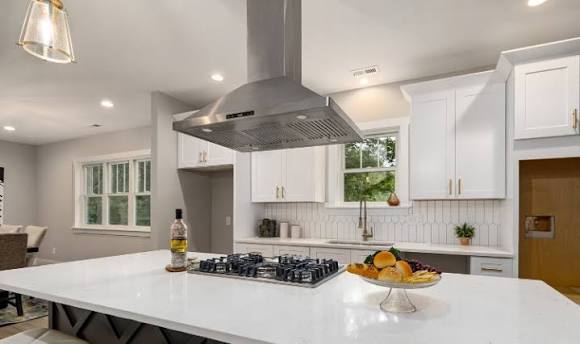

The Air Quality Issue That Most Gas Range Owners Don’t Know About
Gas range cooking produces combustion byproducts — nitrogen dioxide, carbon monoxide, formaldehyde, and particulate matter — that research published in the past decade has identified as a significant indoor air quality concern. A study published in Environmental Science & Technology found that gas stove use can generate nitrogen dioxide concentrations that exceed EPA outdoor air quality standards within cooking zones, and that these concentrations can persist in the home for hours after cooking ends.
The response to this research from public health professionals and building scientists is consistent: gas range ventilation isn’t just about odor and steam management — it’s an indoor air quality intervention with direct health implications, particularly for children and people with respiratory conditions.
Ducted Ventilation: What It Takes to Actually Work
The key distinction from the earlier gas range ventilation article in this series (Vol. 5) bears repeating in the context of combustion byproducts: recirculating (ductless) range hoods filter grease and some particles but do not remove combustion gases — nitrogen dioxide, carbon monoxide, and carbon dioxide pass through charcoal filters back into the kitchen air. For combustion byproduct removal, a ducted range hood that exhausts to the exterior is the only effective option.
Ducted hood effectiveness depends on capture velocity — the hood must be large enough and positioned close enough to capture the cooking plume before it disperses into room air. A hood that’s the same width as or wider than the cooking surface, positioned at the recommended height (18–24 inches above the cooking surface), with adequate CFM capacity for the range’s BTU output, captures the majority of combustion byproducts at the source.
Supplemental Ventilation: When the Hood Isn’t Enough
Even a well-designed range hood doesn’t capture 100% of cooking emissions — some escape the capture zone during high-heat cooking with multiple burners in use, or when the hood’s capacity is exceeded by the cooking activity. Supplemental ventilation strategies address this residual exposure.
Opening a window adjacent to the cooking area during gas range use increases air exchange that dilutes any pollutants that escape the hood. For kitchens without operable windows near the range, a window in an adjacent room opened during cooking combined with an exhaust fan creates a cross-ventilation path. These are behavioral supplements to an adequate hood, not substitutes for one.
Air Quality Monitoring: Making the Invisible Visible
A carbon monoxide detector is required by code in many jurisdictions and provides a safety alert for the most acutely dangerous combustion gas. But CO detectors don’t detect nitrogen dioxide, which research identifies as the more concerning chronic exposure risk from gas range cooking at normal operation.
Indoor air quality monitors that measure NO2, PM2.5 (fine particulate), VOCs, and CO2 (a proxy for ventilation adequacy) provide continuous visibility into what’s actually happening in the kitchen’s air during cooking. This information isn’t alarming in itself — it’s data that informs ventilation behavior: running the hood from the start of cooking (not just when it gets smoky), opening windows during high-heat cooking, and verifying that the hood is actually capturing emissions rather than running without capturing.
The Induction Alternative: A Different Answer to the Same Question
The range ventilation question for gas stoves doesn’t arise for induction cooking, which produces no combustion whatsoever — no combustion gases, no nitrogen dioxide, no carbon monoxide. Induction ventilation still addresses cooking vapors (steam, cooking odors, grease), but without the combustion byproduct concern that makes gas range ventilation an indoor air quality issue rather than just a cooking comfort one.
For households that are considering range replacement, the combustion byproduct research adds another dimension to the gas-vs-induction comparison covered in the kitchen section of this series (Vol. 5). For households maintaining gas ranges, robust ducted ventilation used consistently during all cooking activity is the most effective mitigation available without changing the appliance.