
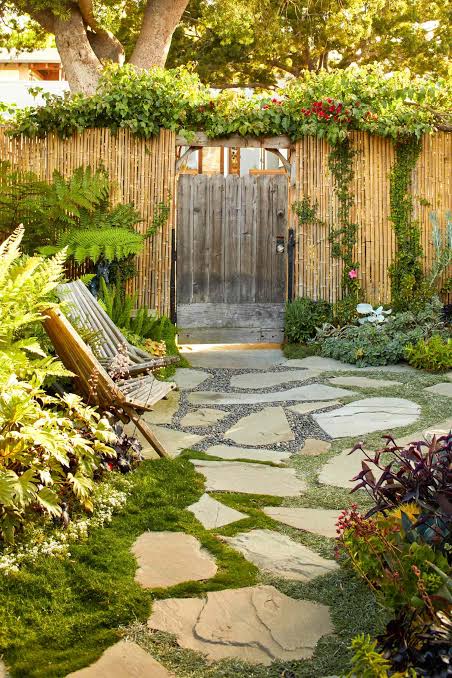

The Feature That Defines How a Garden Is Experienced
Garden paths do more than provide a way to move through the garden without stepping on plants — they determine the pace, direction, and experience of the garden itself. A path that curves gently through plantings encourages slower movement and closer attention to what’s growing on either side. A straight path between two points is efficient but doesn’t invite exploration. A path that disappears around a corner creates the sense of a garden with more to discover.
Path design is garden design — the choice of material, width, curvature, and edging shapes how the garden feels to be in as much as the plants themselves.
Path Width: The Variable That Determines Comfort
Path widths communicate purpose and determine comfort. A primary garden path — the main access from the house to the vegetable garden, the primary circuit through a garden — should be at minimum 36 inches wide (adequate for two people to pass without stepping off the path) and ideally 48 inches wide (comfortable for two people walking side by side). This width also accommodates a garden cart or wheelbarrow without requiring the gardener to step into the beds.
Secondary paths — access paths through raised beds, maintenance paths between plantings — can be 18–24 inches, intended for single-person access while working. The distinction between these two path types should be apparent from the width alone: guests naturally take the wider primary path; the gardener uses the narrower secondary paths for working access.
Material Selection: Each Has a Different Character
Crushed gravel and decomposed granite are the most versatile and most forgiving path materials for informal garden styles. They’re inexpensive, drain well, are easy to install without professional help, and adapt to curved paths and irregular widths easily. Their limitation: they migrate into adjacent beds over time, require occasional raking and replenishment, and don’t provide the clean definition that mortared materials do.
Flagstone and cut stone provide durability, permanence, and a natural quality that photographs beautifully and ages well. Irregular flagstone suits informal cottage and naturalistic garden styles; cut stone with consistent joint widths suits formal garden styles. Setting flagstone in sand (allowing minor adjustment over time) versus setting in mortar (permanent but more expensive) determines the installation commitment and the maintenance approach.
Mulch paths are the most common choice in woodland and shade gardens — organic material (wood chip, bark) that blends with the garden’s naturalistic character, is soft underfoot, and is cheap to install but requires annual replenishment as it breaks down.
Edging: The Detail That Separates Defined From Vague
A path without clear edging gradually loses its definition as plantings spread, gravel migrates, and mulch blurs into adjacent beds. Edging that clearly defines the path boundary maintains the path’s character over time without constant regrading or redefining.
Metal or brick edging installed flush with the path surface is the most durable option and requires the least ongoing maintenance. Low-growing plants used as edging (thyme, creeping phlox, alyssum) create a soft, planted boundary that suits informal garden styles — though they require periodic trimming to keep them from encroaching on the path width. The choice of edging material is an aesthetic decision as much as a practical one; the edging becomes part of the path’s visual character.
Curve Layout: Creating Lines That Feel Natural
Curved garden paths look either natural and flowing or awkward and arbitrary depending on how the curves are drawn. Curves that feel right share characteristics: they follow the contours of the terrain or respond to the plantings on either side (widening where the planting allows and narrowing where it tightens), they transition gradually from straight to curved sections rather than kinking abruptly, and they have a consistent radius through each curved section rather than varying erratically.
The practical technique for laying out flowing garden path curves: use a garden hose to test different curve options before cutting any soil. The hose holds its shape loosely and can be adjusted repeatedly until the curve looks right from multiple viewpoints. Mark the final curve with spray paint, then cut along the mark. A curve that was arrived at through iteration looks better than one drawn with a ruler and compass because it responds to the actual visual reality of the space.