

The Slow Damage Nobody Notices Until It’s Obvious
Hard water damage to bathroom fixtures accumulates gradually — the first month, faucets look fine; by month six, white mineral deposits are visible around the aerator; by year two, the faucet looks dull, the showerhead has visibly blocked nozzles, the glass shower doors have a permanent haze, and the chrome fixtures that looked polished at installation look neglected regardless of cleaning frequency.
The calcium and magnesium carbonates that hard water deposits are not just cosmetic — they reduce water flow through clogged showerhead nozzles, degrade rubber seals and O-rings, and eventually create deposits inside fixture bodies that affect function. Prevention costs minutes; remediation takes hours and sometimes replacement.
The Chemistry of Hard Water Deposits
Understanding why hard water deposits form — and why some cleaning approaches work while others don’t — comes from basic chemistry. Calcium carbonate (limestone) dissolves in acidic conditions and precipitates in alkaline or neutral conditions. Hot water evaporating from a surface leaves the dissolved minerals behind as a deposit that builds up with every evaporation cycle.
This chemistry explains why acid-based cleaners work and why scrubbing alone doesn’t: the calcium carbonate deposit isn’t soft — it’s essentially limestone, which doesn’t abrade away easily. Acidic solutions (white vinegar, citric acid solutions, commercial descalers) dissolve the calcium carbonate chemically, converting it back to a soluble form that wipes away. Scrubbing without acid removes loose surface accumulation but leaves the bonded mineral layer intact.
The Vinegar Method: What Works and What Doesn’t
White vinegar (5% acetic acid) dissolves light to moderate calcium carbonate deposits effectively. For showerheads: fill a plastic bag with undiluted white vinegar, secure it around the showerhead with a rubber band so the head is submerged in the vinegar, and leave for 30–60 minutes (light deposits) to overnight (heavy deposits). The acid dissolves the calcium buildup; nozzles flush clear when the head is removed and run.
Vinegar works less well on heavy, long-established deposits that have calcified over years. For these, a longer soak or a stronger acid (citric acid powder dissolved in water, or commercial descaler products with higher acid concentration) is more effective. Rinse thoroughly after any acid treatment — residual acid on chrome can eventually affect the finish if left in contact.
Chrome and Nickel Finishes: Care Without Damage
Chrome and polished nickel finishes are susceptible to dulling from both hard water deposits and from cleaning products designed to remove them. Prolonged exposure to strong acids (even vinegar) can dull chrome and strip protective coatings if left in contact too long or used too frequently. Cleaning abrasives scratch chrome surfaces, creating microscopic grooves that trap more mineral deposits and accelerate the dullness cycle.
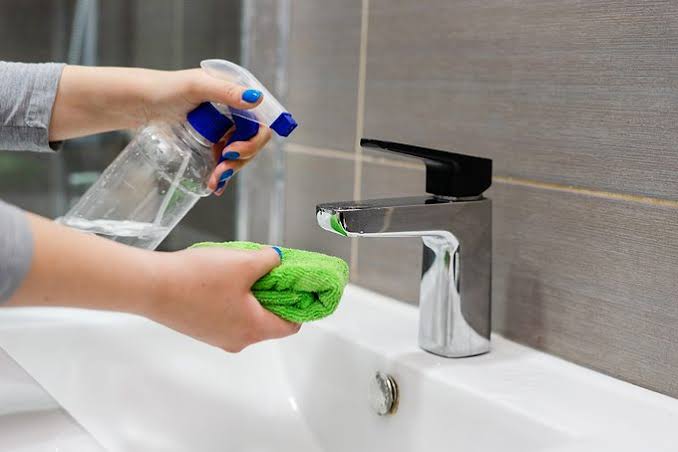
The approach that balances effectiveness with finish protection: apply acid cleaner to a soft cloth rather than directly to the fixture, work in short contact periods (5–10 minutes rather than extended soaks for regular maintenance), rinse thoroughly, and dry immediately after cleaning. Wiping chrome fixtures dry after each use (a 30-second habit) is the most effective preventive measure available — it stops the evaporation cycle that creates deposits in the first place.
Shower Glass: The Hardest Surface to Restore
Hard water etching on glass shower doors is the most difficult hard water damage to address. The calcium carbonate deposits don’t just sit on the glass surface — they bond at a molecular level with the silicon dioxide in the glass, creating deposits that resist acid treatment that works well on metal surfaces. Full etching (where the mineral has bonded into the glass surface itself rather than sitting on it) is not reversible through cleaning — it requires professional glass polishing or door replacement.
Prevention is the only practical strategy for glass shower doors: squeegee the glass after every shower (30 seconds that prevents the evaporation cycle), apply a hydrophobic glass coating (Rain-X or similar products formulated for shower glass) every 1–3 months that causes water to bead and run off rather than evaporating on the surface, and address any mineral buildup monthly rather than allowing it to accumulate between seasonal cleaning sessions